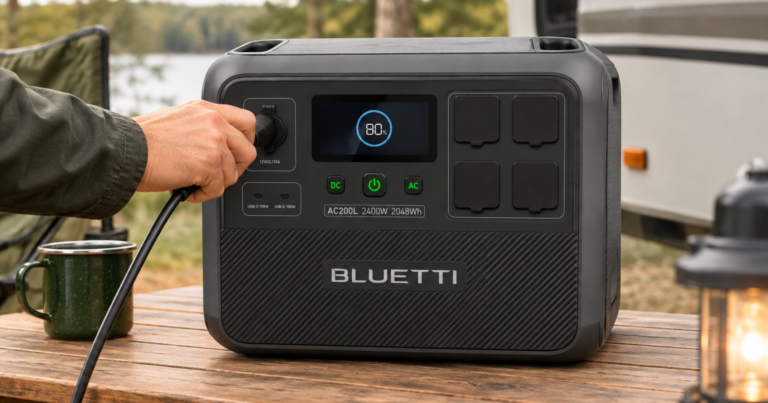
Latest review
BLUETTI AC200L Review: A 2kWh Backup Station With Real Home-Base Appeal
A high-capacity station makes sense only if the weight, output, and expansion path match how you actually use…
Read review →
Smart Power Backup
Compare real runtimes for fridges, CPAPs, tools, and weekend camps before you buy.
Find Your SetupStart exploring
Thinking about buying portable power stations and home backup systems? Our reviews look beyond feature lists to explain the ownership experience, the people each…
Reviews →Portable Power Fundamentals covers the choices and questions that matter most within portable power stations and home backup systems. Start with the essentials, then…
Portable Power Fundamentals →Outage Readiness covers the choices and questions that matter most within portable power stations and home backup systems. Start with the essentials, then explore…
Outage Readiness →Powered Camps covers the choices and questions that matter most within portable power stations and home backup systems. Start with the essentials, then explore…
Powered Camps →Mobile Workdays covers the choices and questions that matter most within portable power stations and home backup systems. Start with the essentials, then explore…
Mobile Workdays →Curious about Charging Strategy? See how it connects with portable power stations and home backup systems, which choices matter in practice and what can…
Charging Strategy →Freshly published
A high-capacity station makes sense only if the weight, output, and expansion path match how you actually use…
Read review →Latest guides & advice

One measured fridge day or router evening can turn battery shopping from guesswork into a calm, usable backup…
Read article →
A lamp, router, coffee ritual, or charged laptop can change the whole feel of an outage—if your battery…
Read article →Smart Power Backup is built for people who want portable power to feel less mysterious and a lot more useful. A power station spec sheet can tell you watt-hours, output ports, inverter size, solar input, battery chemistry, and charge speed, but that does not automatically answer the questions that matter when the lights go out or the truck is packed for a long weekend. Can it keep the fridge cold overnight? Will it run a CPAP safely? How long can it power a laptop, router, fan, heated blanket, induction cooktop, or 12-volt fridge? Is it enough for a campsite, a work van, an apartment outage, or a small home backup setup?
That is where this site comes in. We focus on portable power stations, solar generators, expansion batteries, transfer-ready backup systems, and the accessories that make them easier to live with. The goal is simple: translate battery capacity, wattage, surge ratings, solar limits, and charging options into plain decisions you can actually use before you buy.
Portable power is not just emergency gear anymore. It is part comfort tool, part productivity upgrade, part quiet insurance policy. The same battery that keeps your router and phone alive during a neighborhood outage can also run camp lights, recharge camera gear, power a cooler at a tailgate, or keep a cordless-tool battery topped off on a jobsite. That flexibility is what makes this category exciting, but it also makes choosing the right size harder than it looks.
Smart Power Backup is for homeowners who do not want to jump straight to a whole-house generator, renters who need backup power without permanent installation, RV and van travelers who care about silent off-grid energy, campers who want reliable comfort without fumes, and anyone who works from home and cannot afford to lose internet every time the grid flickers. It is also for the gear-curious person who enjoys comparing battery platforms, solar panels, charging speeds, and clever accessories, but still wants the final recommendation to come back to real use.
A 300Wh unit can be perfect for phones, headlamps, tablets, and short laptop sessions, but it is not the answer for a refrigerator. A 1,000Wh unit can feel like a sweet spot for many homes and camping setups, but output limits still matter. A 2,000Wh to 4,000Wh system starts to feel serious for outage coverage, food protection, medical devices, and longer runtimes, especially with solar or an expansion battery. We help separate “technically possible” from “comfortable, repeatable, and worth paying for.”
The biggest mistake in portable power is buying based on one impressive number. Watt-hours are important, but they are only part of the picture. Inverter output determines what you can run. Surge capacity matters for compressors and pumps. Battery chemistry affects cycle life and long-term value. Solar input controls how quickly you can recover energy off-grid. Weight, handle design, port layout, app controls, fan noise, warranty support, and charging behavior all become more important once the unit is in your house, car, garage, tent, or work van.
We help readers think through the complete setup, not just the box. That includes what size battery fits the job, whether you need LiFePO4 chemistry for long-term use, when a smaller unit is smarter than a heavy flagship model, and when it makes sense to add solar panels, a DC charger, an extension cord, a transfer switch, a battery cart, or a dedicated cable kit.
We like the gear, but we care most about what the gear lets you do. A portable power station earns its place when it protects food during a storm, keeps a bedroom fan running through a hot night, powers a Starlink setup at a remote cabin, or lets you make coffee at camp without firing up a gas generator. Specs matter because they predict those outcomes, not because they look impressive in a comparison table.
That is why our guidance starts with scenarios. If you are preparing for a 12-hour outage, the right answer may be a mid-size LiFePO4 station with enough AC output for your fridge and a plan to recharge from the wall before storm season. If you are building a car-camping kit, you may care more about DC efficiency, cooler runtime, lighting, and fast vehicle charging. If you are backing up remote work, your priorities may be quiet operation, router and modem runtime, laptop charging, UPS-style switchover behavior, and enough reserve capacity to get through a full workday.
For small-scale home backup, we look at the step up from portable convenience to more integrated power. That can mean expansion batteries, higher-output inverters, 240-volt capability for select loads, inlet boxes, manual transfer solutions, or panel-connected systems installed by a qualified electrician. We keep the focus on practical coverage: which circuits matter, how much runtime is realistic, how solar changes the equation, and what daily living feels like when the grid is down.
A good backup setup should feel calm, not complicated. You should know where the power station lives, what it can run, which cables go with it, how often to top it off, and what to unplug when conserving energy matters. During an outage, you do not want to discover that your fridge pulls more surge power than expected, your solar panel cable is too short, or your “whole weekend” battery plan only lasts through the first night.
Smart Power Backup helps you build that confidence before the pressure is on. We explain the tradeoffs behind popular sizes and categories, from compact power banks and lunchbox-style stations to larger expandable systems that can anchor a serious preparedness plan. We pay attention to the little things that make a setup easier to live with: clear displays, reliable AC outlets, strong USB-C output, quiet fans, stable apps, weather-aware solar planning, storage habits, and the difference between marketing runtime and real runtime.
There is also a genuine pleasure in getting this right. A well-matched battery setup makes a campsite feel dialed in. It keeps a camera bag ready, a cooler cold, a laptop charged, and a lantern glowing without noise or exhaust. At home, it turns a power outage from a scramble into a manageable inconvenience. You still respect the limits of stored energy, but you are not guessing in the dark.
The best portable power station is not always the biggest one, the newest one, or the model with the longest feature list. The best choice is the one that fits your load, your budget, your storage space, your charging options, and your tolerance for maintenance and weight. A renter in a city apartment, a family in a storm-prone suburb, a weekend overlander, and a contractor working from a truck may all be looking at the same category, but they do not need the same setup.
Our approach is to help you narrow the field with the questions that matter: What are you powering? For how long? How often will you use it? Can you recharge during the event? Do you need silent indoor-safe power, or do you also have a fuel generator? Will you carry it by hand, roll it from the garage, or mount it as part of a more permanent system? Once those answers are clear, the specs start making sense.
Smart Power Backup exists to make portable power feel approachable without watering it down. Whether you are buying your first compact power station or planning a cleaner, quieter backup system for essential home loads, we help you choose with purpose, set it up intelligently, and trust it when it counts.